
Dog Crate Size Calculator
How to Use the Dog Crate Size Calculator
Measure your dog's length
Measure your dog while standing, from the nose to the base of the tail. Keep the measuring tape straight and record the length in inches or centimetres.
Measure your dog's height
Measure from the floor to the top of your dog's head, accounting for upright ears if necessary. Make sure your dog has enough space to stand and sit naturally.
Calculate and compare crate sizes
Enter your measurements and calculate an estimated crate size. Compare the result with the manufacturer's interior dimensions before buying.
How to Use the Dog Crate Size Calculator
Measure your dog's length
Measure your dog while standing, from the nose to the base of the tail. Keep the measuring tape straight and record the length in inches or centimetres.
Measure your dog's height
Measure from the floor to the top of your dog's head, accounting for upright ears if necessary. Make sure your dog has enough space to stand and sit naturally.
Calculate and compare crate sizes
Enter your measurements and calculate an estimated crate size. Compare the result with the manufacturer's interior dimensions before buying.
What Size Crate Does Your Dog Need?
Choosing the right dog crate is an important part of creating a comfortable, secure resting space for your furry companion.
A crate that’s too small can make it difficult for your dog to stand, turn around or lie down naturally. A well-sized crate gives your dog room to relax without feeling cramped.
The Wagmellow Dog Crate Size Calculator helps you estimate suitable crate dimensions based on your dog’s measurements.
Whether you’re preparing for a new puppy or choosing a crate for an adult dog, accurate measurements are a better starting point than guessing from breed or weight alone.
How Do You Calculate Dog Crate Size?
Start by measuring your dog’s length and height.
A commonly used starting guideline is to allow approximately 3–4 inches (7.6–10.2 cm) of additional room beyond the dog’s measured length and height.
Estimated minimum crate length = Dog’s measured length + 3–4 inches
Estimated minimum crate height = Dog’s measured height + 3–4 inches
For example, if your dog measures 28 inches in length and 23 inches in height:
Estimated crate length: 31–32 inches
Estimated crate height: 26–27 inches
These measurements help you identify an appropriate starting size. Always check the actual interior dimensions, usable width and your dog’s ability to turn around and stretch comfortably.
A calculator cannot guarantee the fit of a particular crate because crate designs and internal measurements vary.
Why Does the Right Crate Size Matter?
Your dog should be able to:
Stand naturally without crouching.
Turn around comfortably.
Sit without their head being forced down.
Lie down in a natural position.
Stretch out without being cramped.
Remember that comfort and welfare are more important than choosing a particular size label.
Helpful tip: When comparing products, pay attention to usable interior space rather than relying only on the external dimensions printed on the packaging.
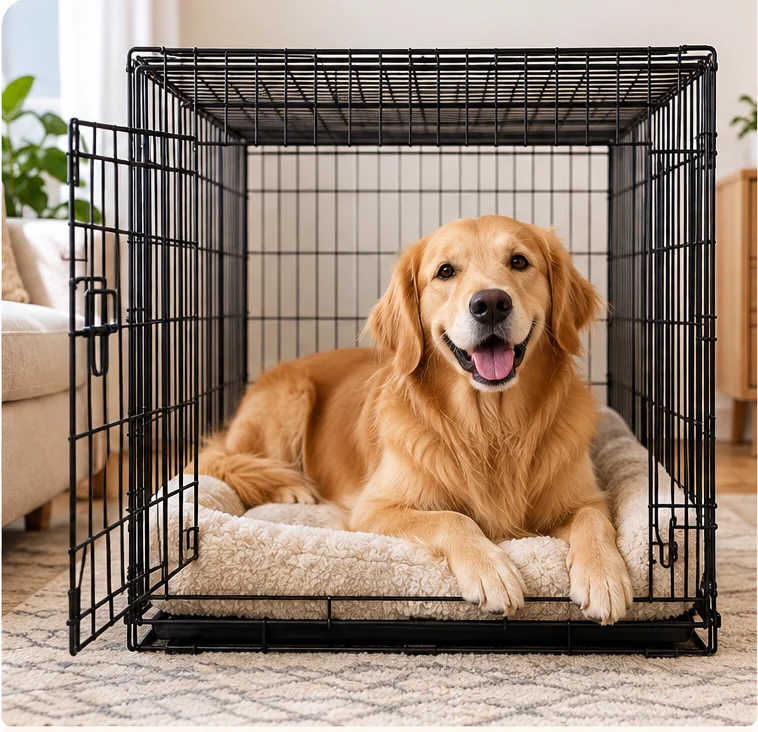
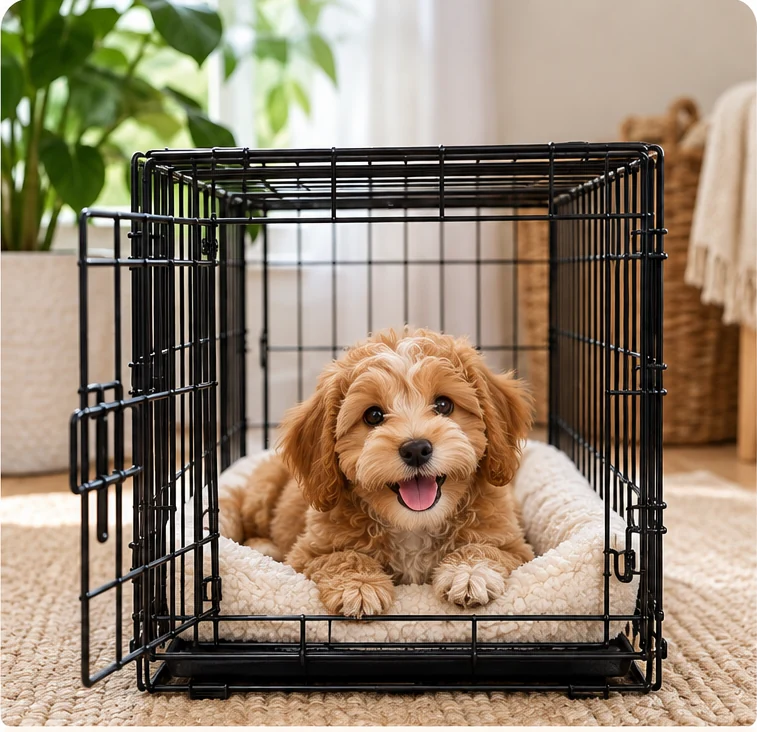
Dog crate comparison
Puppy Crates
Growing puppies need a crate that fits their current size, with room to stand, turn around and rest comfortably.
Adult Dog Crates
Adult dogs need sufficient interior space to stand naturally, turn around, lie down and stretch.
Understanding Different Dog Crate Sizes
Dog crates are commonly sold in size categories such as Small, Medium, Large and Extra Large. Many US retailers also describe them using approximate lengths in inches.
Common advertised lengths include 24, 30, 36, 42 and 48 inches, although dimensions and sizing conventions vary between manufacturers.
A 36-inch crate from one brand may not have exactly the same usable interior space as a 36-inch crate from another.
Always compare your dog’s measurements with the actual internal length, width and height of the crate.
Wire Crates vs Plastic Crates
Wire dog crates: Wire crates generally offer good visibility and ventilation. Many are foldable, making them convenient for everyday home use and storage.
Plastic dog crates: Plastic crates offer a more enclosed design and may be suitable for certain types of travel. Always check ventilation, construction and the transport provider's specific requirements.
Soft-sided crates: Soft-sided crates are lightweight and portable, but they may not suit dogs that chew, scratch or attempt to escape.
Choose the design according to your dog’s needs, behaviour and intended use not appearance alone.
Making Your Dog's Crate Comfortable
Place the crate in a safe, well-ventilated area away from excessive heat and direct sunlight.
Provide appropriate bedding when safe for your dog, and make sure drinking water is accessible.
Introduce the crate gradually using positive experiences, treats and calm encouragement.
Never use a crate as punishment. Dogs also need regular opportunities for exercise, interaction, play and toileting outside their resting space.
A Note About Travel Crates
Home crate sizing guidance does not automatically satisfy airline or vehicle-transport requirements.
If you’re travelling with your dog, check the carrier’s rules and use an appropriately designed and secured travel crate.
A crate suitable for your living room may not be suitable for transporting your dog.
Crate Sizing Disclaimer
The Wagmellow Dog Crate Size Calculator provides general sizing estimates for educational purposes. Actual crate dimensions vary by manufacturer and design.
Always verify that your dog can stand, sit, turn around, lie down and stretch comfortably inside the selected crate.
For travel, recovery after surgery or other specialised uses, follow the relevant transport requirements or your veterinarian’s guidance.
Frequently Asked Questions
How do I measure my dog for a crate?
Measure your dog’s length while standing and their full height from the floor to the top of the head, accounting for upright ears. Allow approximately 3–4 inches of additional clearance as a starting point, then check actual interior crate dimensions.
What size crate does a Golden Retriever need?
Many adult Golden Retrievers use crates advertised around 42 inches long, but this is only a general example. Measure your individual dog and check interior dimensions rather than choosing solely by breed.
What size crate should I buy for a puppy?
Consider a crate designed for your puppy’s expected adult size, with a suitable adjustable divider. Ensure the usable space remains comfortable as your puppy grows.
Can a dog crate be too big?
For home resting, generous space is not inherently harmful. During housetraining, some owners use an adjustable divider, but never restrict space so much that the puppy cannot stand, turn around, lie down and stretch.
Should my dog be able to stand inside the crate?
Yes. Your dog should be able to stand naturally, sit, turn around, lie down and stretch without being forced into an uncomfortable position.
Is a wire or plastic crate better?
Both can work, depending on your dog’s behaviour, the ventilation and the intended use. Wire crates are often convenient at home, while certain plastic crates are designed for transport. Always check construction and suitability.
Can I use the same crate for sleeping and travelling?
Only if the crate is suitable for both purposes. Travel involves additional safety and carrier requirements, so check these separately rather than relying on ordinary home-crate dimensions.